



Bad Luck
How Often It Harms Good Natures
“The Psychology of Luck and Fortune”
The concept of “moral luck”, or the “psychology of luck and fortune,” represents one of the darkest, most realistic, and at the same time deepest intersections of personality psychology, moral philosophy, and the harsh reality of life.
The statement, “How often bad luck harms good natures,” confronts us with the fact that human beings do not live in a moral vacuum; we live within the circumstances of chance, geography, trauma, and genetics.
1. The Philosophical-Psychological Concept of “Moral Luck”
Philosophers such as Bernard Williams and Thomas Nagel were among the first to seriously explore the idea that much of what we call a person’s “moral character” or “good and bad nature” is shaped by factors that lie completely outside their control.
We usually judge people based on their behavior, but psychology shows that luck and fortune influence our character on three levels:
- Constitutive Luck: Genetics, brain structure, neurotransmitter activity, and the temperament with which we are born. Someone born with a highly anxiety-sensitive nervous system may have to struggle several times harder than someone with a more resilient nervous system to preserve qualities such as calmness, compassion, and self-control.
- Circumstantial Luck: The circumstances and situations into which a person happens to be placed. A good nature living in conditions of peace and prosperity can remain generous, fair, and kind relatively easily. But the same nature, when exposed to famine, war, extreme poverty, or repeated trauma, may—under the pressure of survival instincts—begin to display behaviors that even the person themselves never believed they were capable of.
- Causal Luck: The chain of prior events that has shaped us—such as the quality of our childhood attachment, the parents we never chose, and the society in which we grew up.
2. The Psychological Mechanism: How Does “Bad Luck” Wound and Transform a Good Nature?
Clinical psychology and neuroscience help explain why and how continuous exposure to bad luck—losses, repeated failures through no fault of our own, illness, and trauma—can challenge even the purest of natures.
A) The Depletion of Willpower and Self-Regulation
According to modern psychological theories, willpower, patience, and the capacity to live according to one’s moral values are limited resources.
When a person is repeatedly confronted with misfortune, much of their psychological energy is consumed by survival and anxiety regulation. As a result, less mental energy remains for virtues such as empathy, patience toward others, and compassion.
A person who is exhausted and repeatedly wounded becomes more easily frustrated, impatient, and aggressive.
B) Changing Schemas:
The Collapse of the “Just World” Assumption
Many good-natured people unconsciously live with the assumption that “if I am good, the world will treat me well.”
Repeated misfortune shatters this cognitive assumption. When a person sees their effort, honesty, and kindness repeatedly met with injustice and failure, they may experience existential hopelessness.
This collapse of meaning can push a good nature toward darker defensive shelters:
- Chronic pessimism: “Nothing is worth it; being good is pointless.”
- Emotional numbness: In order to prevent further suffering, the person shuts down the empathetic part of themselves.
C) Repeated Trauma and the Physiology of Threat
Continuous misfortune can keep the brain—particularly the amygdala—in a state of constant alert, a fight-or-flight response.
A brain that remains under persistent threat begins to categorize the world in terms of “danger/safety” and people in terms of “attacker/victim.”
In this physiological state, the mental capacity required for moral reasoning, understanding the complexity of other people, and forgiveness becomes severely constricted.
3. The Difference Between “Wounding a Good Nature” and “Moral Collapse”
There is a subtle distinction here that personality psychology addresses:
Bad luck can test, exhaust, and hurt a good nature—but does it necessarily turn that person into someone morally bad?
- Developed natures (with psychological resilience and self-awareness): Misfortune may make them wounded, sad, exhausted, and perhaps somewhat withdrawn, but their moral core—the commitment not to harm others and to remain fair—survives. They transform their own suffering into a means of better understanding the suffering of others. This is related to post-traumatic growth.
- Fragile natures (with weak internal coherence): Misfortune can become a justification for harming others: “Because the world was cruel to me, I have the right to be cruel too.” This transmission of trauma is perhaps the greatest damage that bad luck can inflict upon morality.
4. Psychological Strategies for Facing “Bad Luck” While Protecting a Good Nature
If we find ourselves going through a period of intense misfortune, how can we protect our authentic moral self from exhaustion and erosion?
1. Radical Acceptance Without Self-Blame
We must accept that we are not in control of everything. Many failures and misfortunes are not our fault.
Separating “responsibility for our own actions” from “the random outcomes of the world” can remove an enormous burden of unnecessary shame and guilt from the psyche.
2. Acknowledging Exhaustion and Grief
A good nature has the right to become tired. It has the right to cry, to feel angry, and to distance itself from others for a while in order to rebuild.
Self-acceptance and self-compassion during difficult periods prevent suffering from turning into resentment and malice.
3. Seeking Refuge in Small Circles of Meaning
When misfortune dominates life on a large scale—career, major goals, society—we must keep meaning alive on a much smaller scale:
Talking with a friend, caring for a plant, reading a profound poem, or doing one small good thing for a stranger.
These small acts remind the psyche that it still possesses agency and the capacity for goodness.
4. Separating “Suffering” From “Worthlessness”
Bad luck can damage our external circumstances; it does not determine our inner worth.
Being wounded does not mean that our identity has failed.
As the Stoic philosopher Seneca is often quoted as saying:
“Storms make trees take deeper roots.”
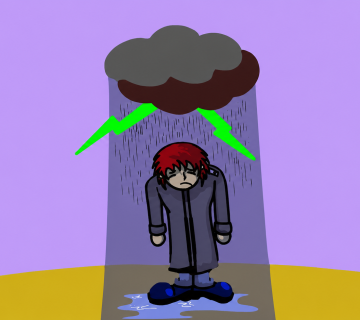
But psychology reminds us that this is not an absolute law. Storms that are too violent can uproot even the most beautiful trees.
Our task in the way we live is therefore to strive to put down deeper roots—through self-care and strengthening resilience—while also building social and human shelters for one another, so that we are less vulnerable when confronted by the storms of unfavorable fortune.
Mental Health
This page shares writings and materials related to psychology and psychiatry.
Dr. Hamid Yousefi’s Website
Psychiatrist
Dr. Hamid Yousefi’s Website




بدون دیدگاه