



The psychological roots of Persian literature — for example, why are sorrow, slyness (rendi), and mysticism so prominent?
To answer this, we must simultaneously draw on individual psychology, collective psychology, political history, and the structure of the language.
Persian literature is not merely a reflection of emotions;
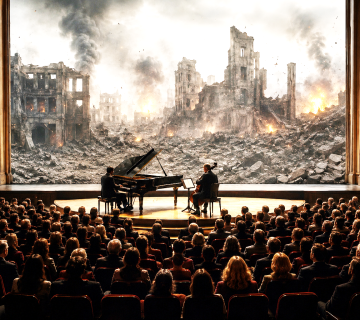
it has been a mechanism for survival and reconstruction of the collective psyche over centuries.
1. Why is “sorrow” so prominent?
a) The historical experience of chronic insecurity
Historical Iran faced:
- successive invasions (Arabs, Mongols, Timurids…)
- recurring despotisms
- structural instability
- economic insecurity
When a society is exposed to structural insecurity for centuries, its collective psyche develops what today we call:
Chronic Existential Insecurity
Meaning:
“The world is not trustworthy.”
In such a context:
- Joy is often fragile and short-lived.
- Loss becomes a familiar, recurring experience.
- Literature becomes the place where collective mourning is processed.
This is why even in the most romantic poems, a shadow of loss is always present.
b) Sorrow as catharsis
In the Iranian tradition, sorrow is not merely suffering; it is a form of purification.
In mysticism:
- sorrow = awakening
- suffering = depth
- tears = cleansing
From a psychoanalytic perspective:
- sorrow in Persian literature serves as a tool for emotional regulation.
- A society unable to protest directly releases tension through poetry.
Through poetry and art,
it cries.
c) The aesthetics of loss
In Iranian culture, loss is beautiful:
- the unattainable beloved
- the absent lover
- the fleeting spring
- the impermanence of the world
This resembles the Japanese concept of mono no aware — a gentle awareness of transience.
In Persian, this becomes a principle:
“Beauty lies in impermanence.”
2. Why is ‘rendi’ (sly, ironic wisdom) so prominent?
Rendi is one of the most complex concepts in Iranian culture.
It is not merely cleverness, hypocrisy, or humor.
A psychological definition of rendi:
“Ironic intelligence in conditions where one cannot speak directly.”
Its roots:
a) Historical despotism and censorship
When power:
- does not tolerate direct criticism,
- merges religion and politics,
- imposes real punishment,
people learn to:
- speak indirectly,
- use double meanings,
- hide the blade beneath a smile.
Hafez is the pinnacle of this mechanism.
b) A psychological defense mechanism
In psychoanalysis, humor and ambiguity are considered among the most mature defense mechanisms.
The rend (the sly one):
- observes,
- understands,
- does not submit,
- yet protects himself.
Rendi = awareness + psychological distance.
c) Historical distrust
When official structures are unreliable:
- formal morality becomes a subject of mockery,
- ostentatious piety is criticized,
- the rend becomes a hero.
The rend is the person who recognizes the contradictions of the system.
3. Why is mysticism so prominent?
Mysticism in Iran is not only spirituality;
it is a psychological–philosophical response to the instability of the world.
a) Compensation for the loss of external control
If the external world is uncontrollable,
control is relocated to the inner world.
In mysticism:
- the outer world is unstable,
- truth lies within,
- external domination is compensated by inner freedom.
b) The need for meaning in suffering
When suffering is structural, one has two choices:
- Nihilism
- Giving meaning to suffering
Mysticism chooses the second path.
Suffering becomes:
- spiritual journey
- test
- separation as a prelude to union
c) A multilayered language
Persian inherently possesses high metaphorical capacity:
- the beloved = God / human / truth / freedom
- wine = love / knowledge / liberation
This multilayering allows the reader to:
- interpret romantically,
- understand politically,
- or read mystically.
This linguistic flexibility strengthened mysticism.
**4. The connection between these three elements
(sorrow + rendi + mysticism)**
These are three different responses to one fundamental problem:
The problem:
An unstable world, unaccountable power, chronic loss.
The responses:
[ Element > Psychological Function ]
| Sorrow > aesthetic acceptance and mourning |
| Rendi > intelligent, ironic resistance |
| Mysticism > relocating meaning into the inner realm |
5. A key question: Are these traits weaknesses or strengths?
From the outside, one may see:
- melancholy
- indirectness
- world-denial
But from within, these have been mechanisms of survival.
If you experience the Mongol invasions,
if you live under centuries of despotism,
if direct speech is dangerous,
you either break
or you become complex.
Iranian culture chose complexity.
6. Do these patterns continue today?
This is the important question.
Do we still:
- gravitate toward sorrow?
- speak indirectly and ironically?
- seek ultimate meaning inside rather than outside?
The answer remains open.
“Society and Mental Health”
Here, writings and materials related to psychology and psychiatry are shared.
ID:
https://ble.ir/jamehvasalamtravan
**Website of Dr. Hamid Yousefi
Psychiatrist**






بدون دیدگاه