


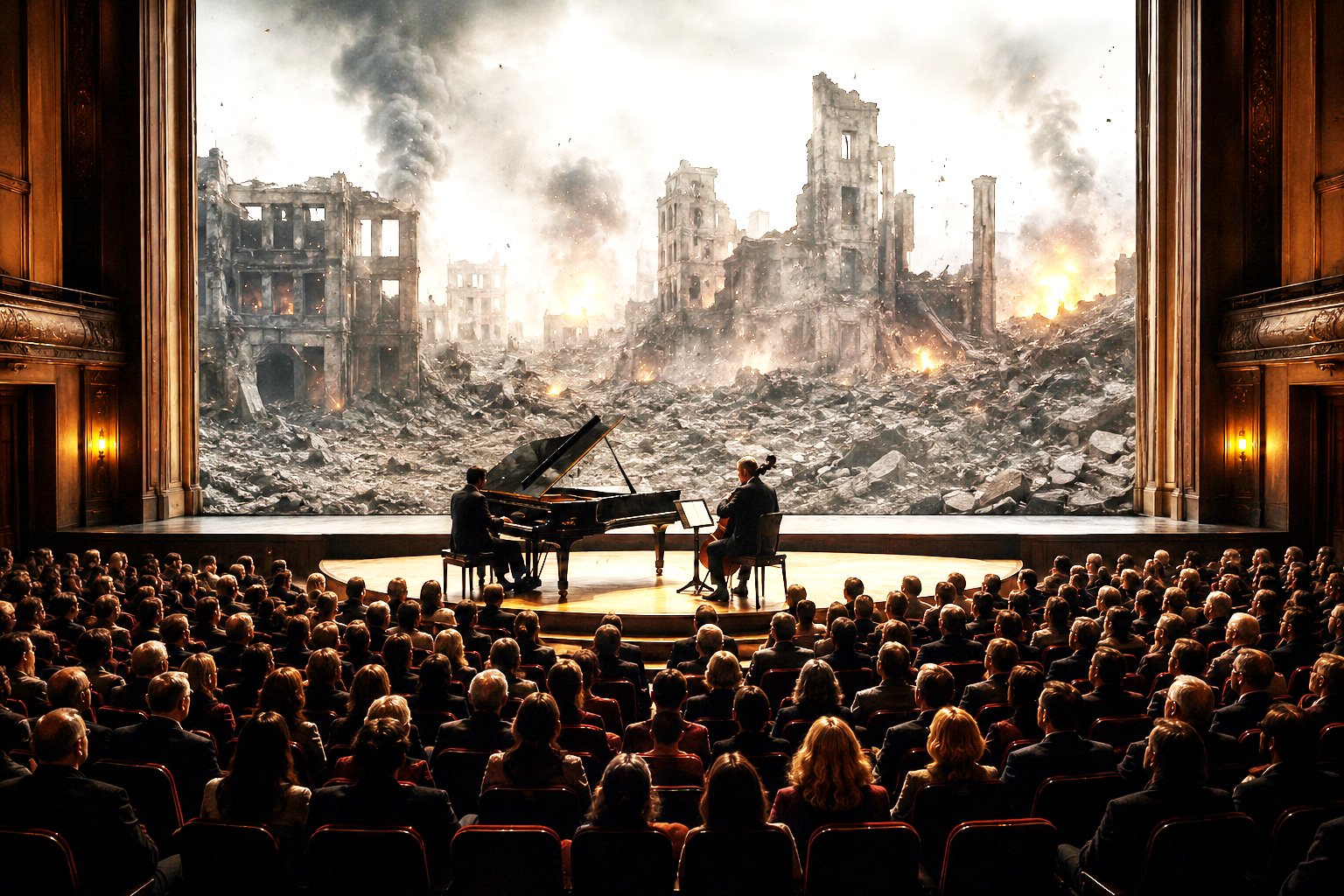
Art and Literature: Breathing Spaces in Times of Crisis
1. Why Do People Turn to Art and Literature During Times of Crisis?
In social psychology, a crisis is not merely a matter of material deprivation or external pressure. A crisis is characterized by:
- A breakdown in predictability,
- The erosion of trust,
- Instability in personal and collective identity,
- And a sense of powerlessness to influence the world.
Under such circumstances, both the individual mind and the collective psyche require what psychologists call “transitional spaces”—spaces that neither dissolve completely into the harshness of everyday reality nor seek to escape it altogether.
Art and literature provide precisely these transitional spaces.
They:
- Give expression to suffering,
- Give form to chaos,
- Transform fragmented experiences into coherent narratives,
- And guide individuals from merely enduring a crisis to understanding and finding meaning within it.
Simply put:
Art and literature do not eliminate crises; rather, they transform them from unnamed sources of pressure into experiences that are more comprehensible and therefore more bearable.
2. What Does a “Breathing Space” Mean?
A breathing space during a crisis is a place where, even momentarily, a person is released from three overwhelming burdens.
A. The Relentless Assault of Reality
Crisis keeps the mind in a constant state of vigilance.
Art interrupts this relentless cycle and gives the psyche an opportunity to recover.
B. Exhausted and Conventional Language
In times of crisis, official and everyday language often becomes incapable of adequately expressing lived experience.
Literature creates a new language—one capable of carrying suffering with greater precision and depth.
C. Silent Isolation
During a crisis, individuals often believe:
“I’m the only one falling apart like this.”
Poetry, novels, music, and cinema reveal that suffering is shared, profoundly human, and communicable.
Thus, art becomes a breathing space because it:
- Gives the psyche room to pause,
- Gives language to experience,
- And reminds people they are not alone.
3. The Social Psychological Functions of Art in Times of Crisis
A. Reconstructing Meaning
One of the deepest wounds inflicted by crisis is the collapse of meaning.
When the future appears uncertain and social order no longer inspires trust, people often feel:
- “Nothing is where it belongs anymore.”
- “Things no longer mean what they once did.”
Literature repairs this rupture by reorganizing experience through:
- Narrative,
- Metaphor,
- Imagery,
- And artistic form.
Social psychologists understand that human beings struggle to withstand collective pressure without coherent narratives.
Art—especially novels and poetry—helps restore that coherence.
B. Cultivating Empathy and Social Connection
During crises, people often become disconnected not only from institutions but also from one another.
Distrust, exhaustion, competition for survival, and collective burnout weaken social bonds.
Here, literature performs something extraordinary.
It allows us to:
- Enter another person’s mind,
- Experience another’s suffering,
- And appreciate the complexity of being human.
This is the expansion of moral imagination.
A society that still reads poetry, writes stories, watches films, and discusses them has not yet dissolved into isolated individuals.
Art remains one of the last places where a shared sense of “we” can still be recreated.
C. Preserving Collective Memory
Crises do not wound only the present—they also damage memory.
One characteristic of turbulent times is that experiences often remain:
- Incomplete,
- Unrecorded,
- Or distorted.
Art and literature serve as the emotional and ethical archive of society.
Official history may remain silent, but novels, poetry, cinema, memoirs, and theater preserve what would otherwise be forgotten.
This is a form of immortality:
Something of human experience, despite all its fragility, survives through language and artistic form.
D. Restoring a Sense of Agency
Prolonged crises generate helplessness:
- “There’s nothing I can do.”
- “Everything is bigger than me.”
Yet creating—or even deeply engaging with—art can foster symbolic agency.
It reminds us:
- I can express my experience.
- I can name what I feel.
- I can bear witness.
- I can create meaning.
This may not immediately transform politics or society.
But it can prevent psychological collapse.
For a society living through crisis, that is not a minor achievement—it is fundamental to survival.
4. Why Are Art and Literature Forms of Immortality?
Immortality can be understood as that which transcends the fleeting moment.
Art and literature do exactly this because they:
1. Carry Individual Experience Beyond Individual Life
Grief, love, failure, hope, and devastation become embedded in artistic works, transcending the limits of personal existence.
2. Transform the Temporary into the Enduring
A crisis eventually passes or changes form.
The poetry born from that crisis remains.
3. Create Dialogue Across Generations
Literature serves as a bridge through time.
Future generations learn through it how those before them suffered, resisted, persevered, and continued to love.
4. Restore Human Dignity Amid Destruction
Crisis reduces people to numbers, case files, headlines, or statistics.
Art restores them as:
- Faces,
- Voices,
- Stories.
Humanity must remain faithful to whatever rescues human experience from the banality of decay; and art and literature are among the greatest forms of that rescue.
5. What Kind of “Breathing Space” Do Art and Literature Provide in a Society Living Through Crisis?
A. Emotional Breathing Space
Poetry, music, fiction, and cinema allow us to experience emotions that daily life often suppresses:
- Grief,
- Anger,
- Longing,
- Regret,
- Hope.
In a society under constant strain, such emotional release and regulation are essential.
B. Linguistic Breathing Space
When public language becomes saturated with clichés, slogans, fear, or censorship, literature creates subtle and indirect ways of speaking.
This is, in itself, a form of psychological freedom.
C. Collective Breathing Space
Watching a film together, reading a poem, quoting a memorable line, or discussing a novel all create small moments of solidarity.
Societies survive through precisely these subtle forms of connection.
D. Temporal Breathing Space
Crisis traps individuals in a suffocating present.
Literature restores movement through time.
It reconnects us:
- To the past,
- To memory,
- To possible futures,
- And to horizons beyond the immediate moment.
6. A Misunderstanding to Avoid
Art and literature are not merely forms of escapism or emotional anesthesia.
To regard them simply as tools for forgetting is to underestimate their true significance.
The authentic role of art during crisis is not merely to distance people from reality.
Rather, it is to make reality:
- More bearable,
- More understandable,
- And, at times, more open to critical reflection.
A breathing space is therefore not an escape from reality.
It is the necessary distance without which understanding, resilience, and resistance become impossible.
7. Conclusion
When the social world becomes unstable and exhausting, very few things make survival genuinely bearable.
Art and literature are among those rare things because they offer human beings:
- Meaning,
- Memory,
- Empathy,
- Language,
- And a sense of endurance beyond the present moment.
They are breathing spaces because they allow both individuals and societies to step back—however briefly—from the suffocation of crisis, recover themselves, and return to the world renewed.
From this perspective, art and literature are not peripheral to life.
They are among the most profound expressions of human immortality.
The Most Concise Conclusion
In a society living through crisis, art and literature are not merely places of refuge.
They are the respiratory system of the collective psyche.
They are where human beings transform suffering into meaning, isolation into connection, and transience into a form of enduring existence.
Society and Mental Health
This channel shares articles and writings related to psychology and psychiatry.
Channel ID:
https://ble.ir/jamehvasalamtravan
Dr. Hamid Yousefi
Psychiatrist


بدون دیدگاه